Lady Fatimah Ma'sumah (a)
What is the reason for the high status of Lady Fatimah Ma'sumah (a) among the Imamzadehs?
Lady Fatimah Ma'sumah (a) (173 - 201 AH) was the daughter of Imam Musa al-Kadhim (a), sister of Imam Reza (a), and one of the virtuous and renowned ladies among Shi'ites.
Her real name was Fatimah, and among her famous titles were Ma'sumah, Karimat Ahl al-Bayt (the Generous Lady of the Household), Shafi'ah (Intercessor), and Tahirah (Pure). In hadiths, she has been attributed with the status of intercession, infallibility, and scholarly standing. Imam Reza (a) considered the reward for visiting his sister's tomb to be like the reward for visiting his own shrine. Many statements about the honor and virtue of Fatimah Ma'sumah (a) have been narrated from Shi'ite scholars.
One of the most significant events in Fatimah Ma'sumah's (a) life was her journey to Iran to meet her brother, Imam Reza (a). It is mentioned in Shi'ite books that during this journey, in the city of Saveh, their caravan was attacked, and some members of her caravan were killed. Fatimah Ma'sumah (a) fell ill after this incident and passed away in Qom after arriving there.
The tomb of Fatimah Ma'sumah (a) is in Qom. Initially, her tomb was a simple grave. This tomb was developed during various governments, especially during Shi'ite governments. The peak of the development of Fatimah Ma'sumah's (a) shrine was during the Safavid era and thereafter.
Status
Fatimah Ma'sumah (a) is considered one of the most virtuous Imamzadehs among Shi'ites.[1] She was the daughter of Imam Musa al-Kadhim (a), the sister of Imam Reza (a), and the aunt of Imam Jawad (a). Her shrine in Qom is considered the second shrine of Ahl al-Bayt (a) in Iran, after the shrine of Imam Reza (a) in Mashhad.[2]
Virtue
Fatimah Ma'sumah (a) is considered to possess the status of intercession.[3] Imam Ja'far al-Sadiq (a) stated that the intercession of Fatimah Ma'sumah (a) would lead to the entry of all Shi'ites into Paradise.[4] Some, relying on this narration, have considered Fatimah Ma'sumah's (a) intercession to be extensive.[5]
Some, relying on a part of the Ziyarat-nameh (pilgrimage supplication) of Fatimah Ma'sumah (a), have considered her the daughter of the spirit and body of Prophet Muhammad (s), Lady Fatimah Zahra (s), Khadijah al-Kubra (s), and the infallible Imams (a).[6] Also, from another part of this Ziyarat-nameh, the status of infallibility for Fatimah Ma'sumah (a) has been proven.[7]
The blessings and virtues related to her soil and pilgrimage are other aspects of Fatimah Ma'sumah's (a) virtue. In some narrations, the reward for visiting Fatimah Ma'sumah (a) is considered Paradise.[8] Many statements about the honor and virtue of Lady Fatimah Ma'sumah (a) have been narrated from Shi'ite scholars.[9] For instance, it is narrated that Mulla Sadra, the Shi'ite philosopher who died in 1050 AH, used to visit her and seek her intercession to solve his scientific and philosophical problems.[10] Also, Sheikh Abbas Qomi (1294-1359 AH), the Shi'ite hadith scholar and historian, called Fatimah Ma'sumah (a) a noble lady and the most virtuous of Imam Musa al-Kadhim's (a) daughters.[11] Many miracles related to her pilgrimage and shrine are mentioned in sources.[12]
Knowledge
Fatimah Ma'sumah (a) is considered among the knowledgeable women and narrators of hadith.[13] Shi'ite and Sunni hadith scholars have included narrations from Fatimah Ma'sumah in their sources. Among these narrations, the following can be mentioned:
1. Muhammad ibn Muhammad al-Jazari (751-833 AH), a Shafi'i hadith scholar and jurist, narrates with intermediaries from Fatimah Ma'sumah (a), and she with intermediaries from the daughters of the Infallibles (a), such as Sakinah daughter of Imam Hussein (a) and Umm Kulthum daughter of Imam Ali (a), from Fatimah Zahra (s) that she said: «Did you forget the words of the Messenger of God (s) on the day of Ghadir Khumm, when he said that whoever I am his master, Ali (a) is also his master, and what he said to Ali (a) that you are to me like Harun (a) was to Musa (a).»[14]
2. Bakr ibn Ahmad narrates from Fatimah daughter of Imam Reza (a), and she from Fatimah Ma'sumah (a), and she with intermediaries from the daughters of the Infallibles (a) from Fatimah Zahra (s) that the Messenger of God (s) used to say that on the Day of Judgment, everyone will be called by their mothers' names except the Shi'ites of Ali ibn Abi Talib (a).[15]
Titles
Many titles have been mentioned for Lady Ma'sumah (a) in sources: among them are Tahirah (Pure), Hamidah (Praised), Birrah (Benevolent), Rashidah (Rightly Guided), Taqiyyah (Pious), Radiyyah (Pleased with God), Mardiyyah (Pleasing to God), Naqiyyah (Pure), Ukht al-Reza (Sister of Imam Reza), Sayyidah Siddiqah (Very Truthful Lady), Sayyidah Radiyyah Mardiyyah (Lady Pleased with God and Pleasing to Him), Muhaddithah (Narrator of Hadith), Abidah (Worshipper), and Sitti (Mistress/Lady).[16]
Ma'sumah is another famous title of the daughter of Imam Kadhim (a). This title is derived from a narration attributed to Imam Reza (a): «Man zara al-Ma'sumah bi Qum ka man zarani؛ Whoever visits Ma'sumah in Qom is like one who has visited me.» Although the title Ma'sumah does not imply infallibility at the level of the infallibles (a), it indicates her possession of a lower rank in the status of infallibility; a rank not found in ordinary people.[17]
Another title of Lady Ma'sumah (a) is Karimat Ahl al-Bayt. Ayatollah Mar'ashi Najafi (1276-1369 SH), a Shi'ite Marja' Taqlid, stated that Imam Muhammad al-Baqir (a) or Imam Ja'far al-Sadiq (a) told his father in a dream: "You must go to Karimat Ahl al-Bayt."[18] Shafi'ah (Intercessor) is another title of Fatimah Ma'sumah (a). It is narrated from Imam Sadiq (a): «A lady from my descendants named Fatimah, daughter of Musa, will pass away in Qom, and through her intercession, all our Shi'ites will enter Paradise.»[19]
Biography

Not much information is available about the life of Lady Ma'sumah (S); including details about her birth and death dates and other aspects of her life.[20] According to some later sources, her birth occurred in the year 173 AH, during the caliphate of Harun al-Rashid, in Medina. Fatimah Ma'sumah lost her father, Imam Kadhim (A), at the age of ten.[21] Fatimah Ma'sumah's (S) father was Imam Musa al-Kadhim (A), the seventh Imam of the Shi'ites, and her mother was Najmah, one of the virtuous ladies. Shaykh Saduq narrated that Najmah Khatun was known for her intellect, wisdom, obedience, worship, and adherence to etiquette. Historical sources explicitly state that Imam Reza (A) and Lady Ma'sumah (A) shared the same mother.[22]
Lady Ma'sumah (S) did not marry during her lifetime. Some attribute her unmarried status to not finding an equal or someone worthy of her.[23] One of the possibilities mentioned regarding her not marrying is that Imam Kadhim (A) himself advised his daughters not to marry. Opponents of this claim have rejected such a will as being contrary to the Sunnah of the Prophet (S) and the conduct of the Ahl al-Bayt (A). Some have also said that the severe repression during the eras of Harun and Ma'mun al-Abbasi prevented anyone from easily visiting the house of Musa ibn Ja'far and becoming a son-in-law of that family. Furthermore, the imprisonment of Lady Musa ibn Ja'far (A), his martyrdom in prison, the summoning of Imam Reza (A) to Khorasan, and the Imam's separation from his sisters contributed to this reason.[24]
Journey to Iran and Demise
The author of the Tarikh-e Qom states that in the year 200 AH, Ma'mun, the Abbasid Caliph, summoned Imam Reza (A) from Medina to Marv to be his heir apparent. The Imam's sister, Fatimah Ma'sumah (S), set out for Iran in 201 AH with the intention of visiting her brother. It is said that Lady Fatimah Ma'sumah (S) had prepared for the journey after receiving her brother's letter.[25]
Fatimah Ma'sumah (S) traveled towards Tous in Iran in 201 AH. On this journey, five of Fatimah Ma'sumah's (S) brothers, namely Fadhl, Ja'far, Hadi, Qasim, and Zayd, along with several of her nephews and some servants, accompanied her. According to some, Fatimah Ma'sumah (S) traveled with 23 brothers and nephews. Others have stated that Lady Ma'sumah (S) was accompanied by only one servant on this journey.[26] Fatimah Ma'sumah (A) endured the hardships of this long journey until she reached the city of Saveh. The people of that city, who at that time were enemies of the Ahl al-Bayt (A), attacked her caravan. A fierce battle ensued, and all of her brothers and nephews were martyred. The grief of the martyrdom of 23 relatives eventually led Fatimah Ma'sumah to fall ill. The people and nobles of Qom, who were lovers of the Prophet's (S) family, upon learning of this incident, went to Saveh and, after meeting Fatimah Ma'sumah (S), took her to Qom at her request. Fatimah Ma'sumah spent seventeen days in the house of one of the elders of Qom, named Musa ibn Khazraj Ash'ari, while she was ill. Finally, Fatimah Ma'sumah (S) passed away on the tenth of Rabi' al-Thani in the year 201 AH in the city of Qom.[27]
The exact date of Fatimah Ma'sumah's (S) demise is not mentioned in early sources; however, later sources state her death anniversary as the tenth of Rabi' al-Thani in 201 AH, at the age of 28. Some have also recorded the twelfth of Rabi' al-Thani. Some researchers believe that both dates are estimates.[28] According to another report, after that attack in Saveh, enemies poisoned Fatimah Ma'sumah's (S) food, and that poison caused her illness and ultimately her martyrdom after seventeen days.[29]
Some have said that given the military conflict with Fatimah Ma'sumah's (S) caravan, her martyrdom was probable, as her illness was influenced by this war. The report in the Tarikh-e Qom, stating Fatimah Ma'sumah's (S) death due to illness, can be interpreted as reflecting the conservative stance of the dominant Ash'aris who tried to maintain their relationship with the Abbasid government. The author of the Tarikh-e Qom was one of the Ash'aris.[30]
Ziyarat-nameh and Reward of Pilgrimage
The pilgrimage to Lady Fatimah Ma'sumah holds a special status in the words of the Ahl al-Bayt, and narrations have been issued regarding its importance. These narrations speak of the reward for visiting her.[31]
- Sa'd ibn Sa'd asked Imam Reza (peace be upon him) about the pilgrimage to Fatimah, daughter of Musa? The Imam said: Template:متن عربی[32] [33]
- Imam Jawad (peace be upon him) said regarding the virtue of visiting the grave of his aunt: Template:متن عربی[34]
Ziyarat-nameh
Allamah Majlisi in his book Bihar al-Anwar and some other works has narrated a Ziyarat-nameh for Lady Fatimah Ma'sumah.[35] which is recited today beside her shrine.
This Ziyarat-nameh begins with divine invocations, and initially, near the grave and facing the Qibla, one should recite 34 times Allahu Akbar, 33 times Subhanallah, and 33 times Alhamdulillah, and then the text of the Ziyarat-nameh is recited.[36]
Shrine
According to historical sources, Fatimah Ma'sumah (peace be upon her) was buried in the Bagh-e Babalan neighborhood of Qom.[37] Initially, a mat was placed over her grave.[38] After that, the shrine of Lady Fatimah Ma'sumah (peace be upon her) underwent many changes and developments throughout history and expanded in different periods.[39] The construction of the sanctuary of Fatimah Ma'sumah (peace be upon her) began in the mid-3rd century AH, and from the 4th to the 6th centuries, it had a dome and cupola and was decorated.[40] However, until before the Safavid era, there was no magnificent zarih or iwan for the shrine.[41]
During the Safavid period, the shrine was expanded, including the construction of the Atiq courtyard and the Golden Iwan.[42] The expansion of the shrine continued during the Qajar period. Fath-Ali Shah Qajar paved the floor of the shrine with marble. According to the inscription in the shrine, the mirror-work on the walls of the shrine also began during Fath-Ali Shah's reign and was completed during Muhammad Shah's era.[42] During the reign of Naser al-Din Shah Qajar, the Atabak courtyard was also built.[43] After the Islamic Revolution of Iran, the shrine was also expanded, and sections such as the Imam Khomeini Shabestan were added to the shrine.[44]
After the Islamic Revolution of Iran, the shrine was also expanded, and sections such as the Imam Khomeini Shabestan were added to the shrine.[44]
Courtyards and Porticos
The shrine of Lady Fatimah Ma'sumah (peace be upon her) has several courtyards:
- Atiq Courtyard, which is called the Small Courtyard, Old Courtyard, and today Imam Hadi (peace be upon him) Courtyard. This courtyard is square-shaped and has three iwans. The Golden Iwan is located in this courtyard.[45]
- Atabaki Courtyard, which is called the New Courtyard and today Imam Reza (peace be upon him) Courtyard. This courtyard was built during the reign of Naser al-Din Shah Qajar by Mirza Ali Asghar Khan Atabak. The Mirror Portico, which was built in 1130 AH by order of Ali Akbar Khan Atabak, is located in this courtyard.[46]
- Saheb al-Zaman (peace be upon him) Courtyard, which has an area of about 8000 square meters and has four entrances. This courtyard is located next to the Imam Khomeini Shabestan.[44]
- Jawad al-A'immah (peace be upon him) Courtyard; this courtyard, which has an area of more than 15000 square meters, was built over the Qomrud river. This courtyard, with four main entrances and two emergency entrances, was built in the late 1380s.[47]
- Payambar-e A'zam (peace be upon him) Courtyard; the construction of this courtyard began in the late 1380s.[48]
There are six porticos in the shrine of Lady Fatimah Ma'sumah (peace be upon her), most of which have a smaller dome than the main dome of the shrine. Three porticos were built by the Safavids, two by the Qajars, and one belongs to the contemporary era.[49]
Zarih
The first zarih of the tomb of Lady Fatimah Ma'sumah (peace be upon her) was built by Shah Tahmasp I. Shah Tahmasp later installed another zarih made of white and transparent steel around the previous zarih. This zarih was replaced in 1000 AH by Shah Abbas I Safavid with another zarih. Fath-Ali Shah Qajar covered this zarih with silver plates in 1245 AH and placed it on a marble base. After some renovations, its shape was finally changed in 1348 SH, and its height was increased.[50] In 1380 SH, the zarih of Lady Fatimah Ma'sumah (peace be upon her) underwent a complete reconstruction.[51]
Dome
The first dome over the tomb of Lady Fatimah Ma'sumah was built by a woman named Zaynab,[52] whom some have considered to be the daughter of Imam Jawad (peace be upon him).[53] "Amir Abu al-Fadl Iraqi", the ruler of Qom during the Seljuk period, built a new dome.[54] In 925 AH, Shah Begum Safavi demolished this dome and built another dome, which remains today. This dome was decorated with 12000 gold bricks in 1518 AH by order of Fath-Ali Shah. The height of this dome from the roof of the shrine is 16 meters and from the ground is 32 meters.[55] The dome was renovated in the 1380s SH during the Islamic Republic period.[56]
Minarets
- There are two minarets in the Atabaki Courtyard, which are among the tallest structures of the shrine and are located above the Mirror Iwan.
- Two minarets are located on the other side of the Atabaki Courtyard, opposite the Mirror Iwan.
- Two minarets were built in the Golden Iwan in the Atiq Courtyard, which are covered with spiral knot tiles.[57]
Gallery
-
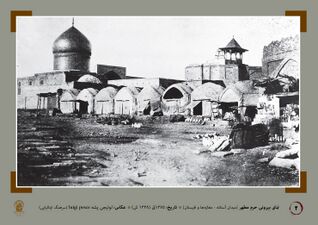 Exterior view of the Shrine of Fatimah Ma'sumah (SA) from Astaneh Square (1859 CE).
 -
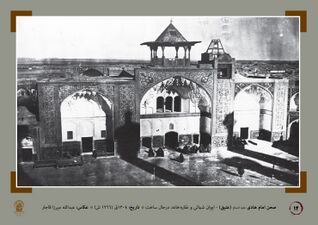 Atiq Courtyard and Naqqareh Khaneh (1887 CE).
 -
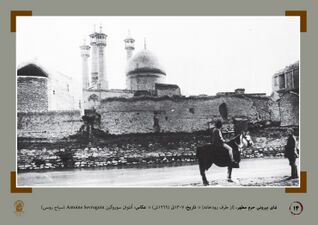 Exterior view of the Shrine of Fatimah Ma'sumah (SA) from Qom-rud and high walls built to prevent floods from entering the shrine (1890 CE).
 -
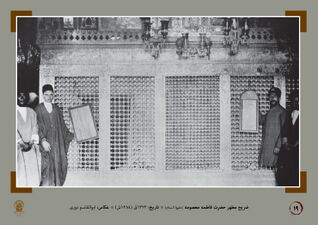 Zarih of the tomb of Fatimah Ma'sumah (SA) (1905 CE).
 -
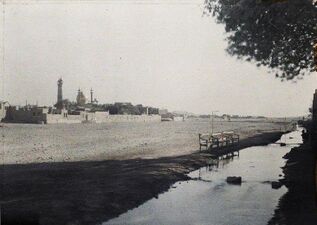 Panoramic view of the Shrine of Fatimah Ma'sumah (SA) (1927 CE).
 -
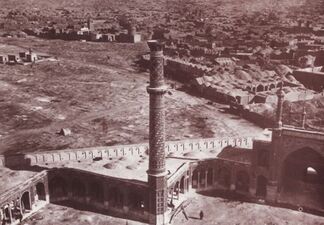 An image of a part of the Atabaki Courtyard.
 -
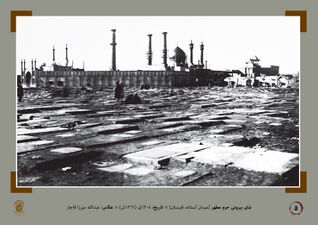 Exterior view of the Shrine of Fatimah Ma'sumah from Astaneh Square (1887 CE).
 -
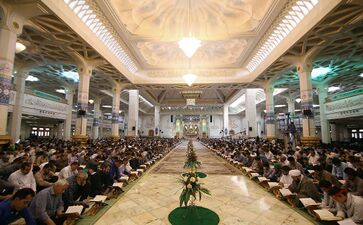 Collective recitation of the Quran in the Imam Khomeini Shabestan of the Shrine of Fatimah Ma'sumah (SA).
 -
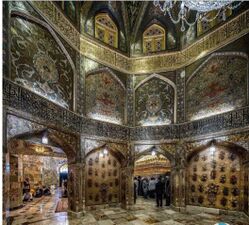 A view of one of the porticos of the Shrine of Fatimah Ma'sumah (SA).
 -
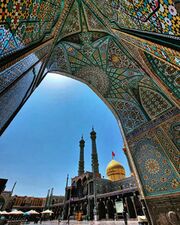 A view of the dome and minarets of the Atabaki Courtyard of the Shrine of Fatimah Ma'sumah (SA).


References
- ↑ Qomi, Abbas ibn Muhammad Reza, 'Montaha al-Amal fi Tarikh al-Nabi wa al-Al', Qom, Daftar Nashr Islami, vol. 2, p. 378.
- ↑ Eshaqi, Sayyid Hussein, 'Mahtab Ahl al-Bayt (A Journey into the Life of Karimat Ahl al-Bayt Lady Ma'sumah)', Qom, Markaz Pazhuheshhaye Islami Seda va Sima, 1386 SH, pp. 3-6.
- ↑ Mohammadi Eshtehardi, Mohammad, 'Lady Ma'sumah (a) Fatimah II', Qom, Nashr Akhlaq, 1380, pp. 178-179.
- ↑ Al-Majlisi, 'Bihar al-Anwar al-Jami'ah li Durar al-Akhbar al-Aimmah', Beirut, Dar Ihya al-Turath al-Arabi, 1403 AH, vol. 57, p. 228.
- ↑ Mohammadi Eshtehardi, 'Lady Ma'sumah (a) Fatimah II', pp. 178-179.
- ↑ Mohammadi Eshtehardi, Mohammad, "Lady Ma'sumah (a), the Shining Star of the Household of Muhammad (s)", Pasdar Islam Journal, no. 177, 1357.
- ↑ Mohammadi Eshtehardi, 'Lady Ma'sumah (a) Fatimah II', p. 159.
- ↑ Ibn Qulawayh, Ja'far ibn Muhammad, 'Kamil al-Ziyarat', edited by Abd al-Husayn Amini, Najaf, Dar al-Murtadawiyyah, p. 324.
- ↑ For some examples, see: Mohammadi Eshtehardi, Mohammad, "Lady Ma'sumah (a), the Shining Star of the Household of Muhammad (s)".
- ↑ Qomi, Abbas ibn Muhammad Reza, 'Al-Fawa'id al-Radawiyyah fi Ahwal Ulama al-Madhhab al-Ja'fariyyah', edited by Nasser Baqeri Bidhendi, Qom, Bustan-e Ketab, 1385, p. 618.
- ↑ Qomi, 'Montaha al-Amal', vol. 2, p. 378; also: Qomi, Abbas ibn Muhammad Reza, 'Mafatih al-Jinan', Qom, Entesharat Osvah, undated, p. 562.
- ↑ For detailed information, see: Mohammadi Eshtehardi, 'Lady Ma'sumah (a) Fatimah II', pp. 191-219.
- ↑ Sadeghi Ardestani, Ahmad, 'Zanan Daneshband va Rawi Hadith', Qom, Markaz Entesharat Daftar Tablighat Islami, 1377, pp. 350-351.
- ↑ Ibn al-Jazari, Muhammad ibn Muhammad, 'Asna al-Matalib fi Manaqib al-Imam Ali (a)', Isfahan, Maktabat al-Imam Amir al-Mu'minin Ali (a) al-Ammah, pp. 50-51.
- ↑ Al-Qomi, Abbas ibn Muhammad Reza, 'Safinat al-Bihar wa Madinat al-Hikam wa al-Athar', Tehran, Dar al-Usrah li al-Tiba'ah wa al-Nashr, 1392, vol. 4, p. 545.
- ↑ Na'ini Ardestani, Mohammad Ali ibn Hussein, 'Anwar al-Musha'shi'in', edited by Mohammad Reza Ansari Qomi, Qom, Ketabkhaneh Bozorg Hazrat Ayatollah al-Uzma Mar'ashi Najafi, vol. 1, p. 211; also: Rafi'i, Ali, 'Tarikh Zendegani Imam Kadhim (a)', Tehran, Sepah Pasdaran Enghelab Islami, Namayandegi Vali Faqih, Edareh Amoozeshhaye Aqidati Siyasi, p. 21.
- ↑ Rafi'i, 'Tarikh Zendegani Imam Kadhim (a)', p. 21.
- ↑ Rafi'i, 'Tarikh Zendegani Imam Kadhim (a)', p. 21.
- ↑ Rafi'i, 'Tarikh Zendegani Imam Kadhim (a)', p. 21.
- ↑ Mahallati, Riyahin al-Shari'ah, vol. 5, p. 31.
- ↑ From Birth to Death, Comprehensive Portal of the Holy Shrine of Lady Fatimah Ma'sumah (S), article posted: 1398, accessed: 1401.
- ↑ A group of writers, Encyclopedia of Imam Kadhim (A), no place, Ashura Specialized Website, no date, p. 338.
- ↑ Ilhami, Davud, Sayri dar Tarikh-e Tashayyu, Qom, Maktab Islam, 1375, p. 545.
- ↑ Hosseini, Sayyid Javad, "Raz-e Adam-e Ezdevaj-e Hadhrat-e Ma'sumah (S)," Farhang-e Kowsar, 1386, no. 69.
- ↑ Faqihi, Ali Asghar, Tarikh-e Madhhabi-ye Qom, Qom, Entesharat-e Za'er, 1387, p. 92.
- ↑ From Birth to Death, Comprehensive Portal of the Holy Shrine of Lady Fatimah Ma'sumah (S), article posted: 1398, accessed: 1401.
- ↑ Rafi'i, Tarikh-e Zendegani-ye Imam Kadhim (A), pp. 24-25.
- ↑ 23 Rabi' al-Awwal, the anniversary of the arrival of Lady Fatimah Ma'sumah (S), Library of Faqahat School, article posted: 1396, accessed: 1401.
- ↑ Tashid, Ali Akbar, Hadiyeh-ye Isma'il ya Qiyam-e Sadat-e Alavi baraye Tasahob-e Khilafat, Tehran, Dar al-Kutub al-Islamiyah, 1385 SH, p. 166.
- ↑ Pak, Mohammad Reza, "Qom dar Do Qarn-e Avval-e Hejri," Tarikh-e Islam, Islamic Propagation Office of Qom Seminary, 1382, no. 14, p. 10.
- ↑ Template:یادکرد ژورنال
- ↑ Ibn Qulawayh, Ja'far ibn Muhammad, Kamil al-Ziyarat, Najaf Ashraf, Dar al-Murtadawiyyah, first print, 1356 SH, Bab 106, p. 324, Hadith 1.
- ↑ Ibn Babawayh, Muhammad ibn Ali, Uyun Akhbar al-Reza (peace be upon him), Tehran, Nashr-e Jahan, first print, 1378 AH, Bab 67, vol. 2, p. 267, Hadith 1.
- ↑ Ibn Qulawayh, Ja'far ibn Muhammad, Kamil al-Ziyarat, Najaf Ashraf, Dar al-Murtadawiyyah, first print, 1356 SH, Bab 106, p. 324, Hadith 2.
- ↑ Majlisi, Bihar al-Anwar, vol. 99, pp. 266-267; also: Majlisi, Muhammad Baqir, Tuhfat al-Za'ir, Qom, Imam Hadi (peace be upon him) Institute, 1386 SH, p. 4; also: Majlisi, Zad al-Ma'ad, Beirut, Mu'assasat A'lami lil-Matbu'at, 1423 AH, pp. 548-547.
- ↑ Majlisi, Bihar al-Anwar, vol. 99, pp. 266-267.
- ↑ Kiani, Yusuf, "Majmu'eh-ye Haram-e Hazrat-e Ma'sumah (S)", Daneshkadeh-ye Adabiyat va Olum-e Ensani-ye Daneshgah-e Tehran, no. 151, Fall 1378 SH, p. 64.
- ↑ Sajjadi, Sadegh, "Astaneh-ye Hazrat-e Ma'sumah", Da'irat al-Ma'arif-e Bozorg-e Eslami, Tehran, Markaz-e Da'irat al-Ma'arif-e Bozorg-e Eslami, vol. 1, p. 360.
- ↑ Sajjadi, "Astaneh-ye Hazrat-e Ma'sumah", Da'irat al-Ma'arif-e Bozorg-e Eslami, vol. 1, pp. 358-362.
- ↑ Sotudeh, Manuchehr, Ketab-ha-ye Haram-e Motahhar-e Hazrat-e Ma'sumah (S) va Hazireh-ha-ye Atraf-e An, Qom, Ketabkhaneh-ye Hazrat-e Ayatollah al-Ozma Mar'ashi Najafi, 1375 SH, p. 19.
- ↑ Rezaei Nadushan, "Seyr-e Tahavvol-e Haram-e Hazrat-e Ma'sumah (S)", Motale'at-e Memari-ye Iran, p. 92.
- ↑ 42.0 42.1 Sajjadi, "Astaneh-ye Hazrat-e Ma'sumah", Da'irat al-Ma'arif-e Bozorg-e Eslami, vol. 1, p. 359.
- ↑ Vazin Afzal, Mehdi, "Tose'eh-ye Haram-e Hazrat-e Ma'sumah va Afzayesh-e Za'eran-e Qom dar Dowreh-ye Naser al-Din Shah", Pazhuhesh dar Tarikh, second year, no. 3, Fall 1390 SH, p. 65.
- ↑ 44.0 44.1 44.2 "Haram-e Hazrat-e Ma'sumah", Reisen Iran website, date of publication: June 3, 1401 SH, date of visit: January 4, 1401 SH.
- ↑ Sajjadi, "Astaneh-ye Hazrat-e Ma'sumah", Da'irat al-Ma'arif-e Bozorg-e Eslami, vol. 1, p. 360.
- ↑ Sajjadi, "Astaneh-ye Hazrat-e Ma'sumah", Da'irat al-Ma'arif-e Bozorg-e Eslami, vol. 1, pp. 360-361.
- ↑ "Haram-e Hazrat-e Ma'sumah" Reisen Iran website.
- ↑ "Haram-e Hazrat-e Ma'sumah" Reisen Iran website.
- ↑ Sajjadi, "Astaneh-ye Hazrat-e Ma'sumah", Da'irat al-Ma'arif-e Bozorg-e Eslami, vol. 1, pp. 360-361.
- ↑ Sajjadi, "Astaneh-ye Hazrat-e Ma'sumah", Da'irat al-Ma'arif-e Bozorg-e Eslami, vol. 1, pp. 359-360.
- ↑ "Historical evolution of the holy zarih of Lady Fatimah Ma'sumah (peace be upon her) from beginning to present", ISNA, date of publication: August 10, 1395 SH, date of visit: January 1, 1401 SH.
- ↑ Sajjadi, "Astaneh-ye Hazrat-e Ma'sumah", Markaz-e Da'irat al-Ma'arif-e Bozorg-e Eslami, vol. 1, p. 360.
- ↑ Nadushan, Mohammad Rezaei, "Seyr-e Tahavvol-e Haram-e Hazrat-e Ma'sumah (S)", Motale'at-e Memari-ye Iran, no. 16, Fall and Winter 1398 SH, p. 92.
- ↑ ""Astaneh-ye Moqaddaseh-ye Hazrat-e Ma'sumah Alayha Salam (Qom)", Ma'aref-e Eslami (Sazman-e Owqaf), no. 29, Shahrivar 1357 SH, p. 56.
- ↑ Sajjadi, "Astaneh-ye Hazrat-e Ma'sumah", Da'irat al-Ma'arif-e Bozorg-e Eslami, vol. 1, p. 360.
- ↑ Faqih Mirzayi, Hossein, "Reconstruction plan of the holy dome of Lady Fatimah Ma'sumah (peace be upon her)", Hawzah Information Center, date of publication: April 21, 1382 SH, date of visit: January 3, 1401 SH.
- ↑ "History of the Shrine of Lady Fatimah Ma'sumah (peace be upon her)", Hawzah Information Center, date of publication: July 15, 1397 SH, date of visit: January 1, 1401 SH.